What Is an LNG Carrier? How Gas Ships Carry Liquefied Natural Gas
Last updated: 26 October 2026 · By Steve Joury, cargo trip advisor at CargoHolidays
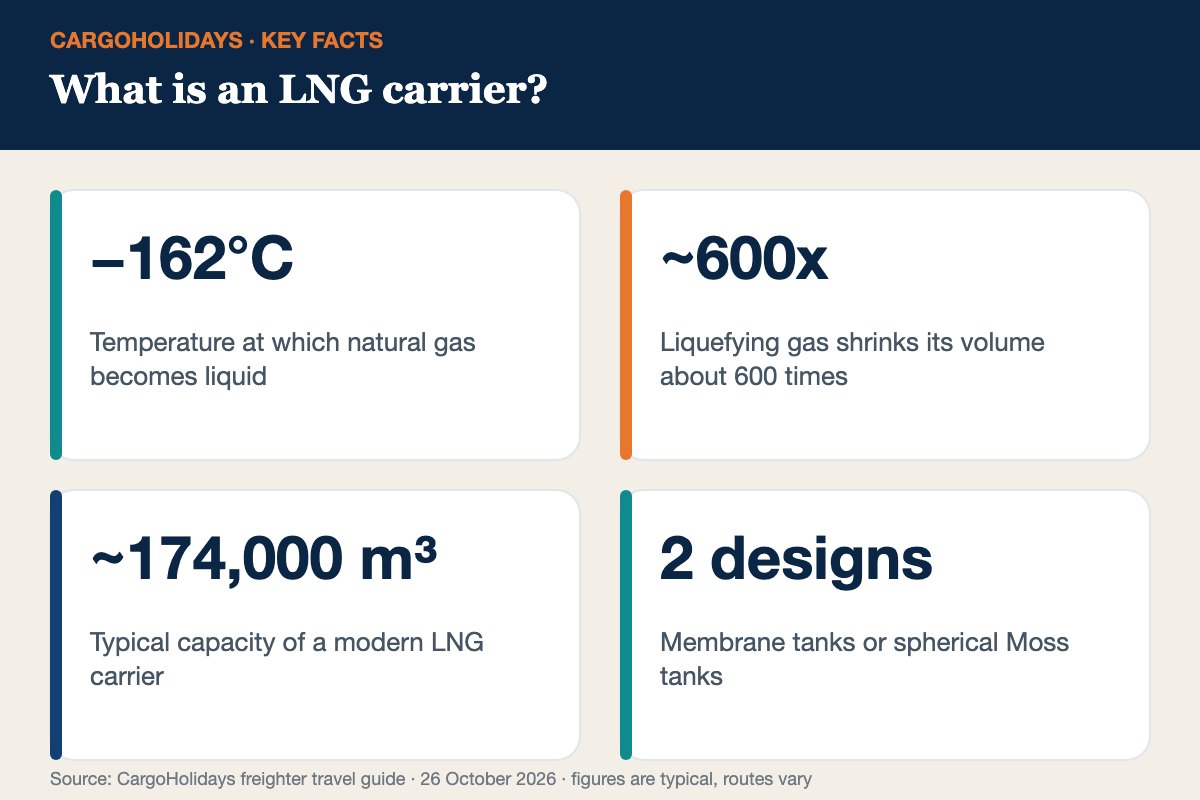
An LNG carrier is a specialised tanker that carries liquefied natural gas, cooled to about −162°C so it shrinks to roughly 1/600th of its volume as a gas. These high-tech ships are among the most expensive cargo vessels built. Here’s how they work.
Liquefying gas reduces its volume about 600 times.
Typical LNG carriers hold around 170,000–180,000 m³.
Tanks are either membrane type or spherical (Moss).
A little cargo ‘boils off’ each day and is often used as fuel.
What is an LNG carrier?
What is an LNG carrier? It’s a gas tanker built to move liquefied natural gas from export terminals to import terminals around the world. The cargo is kept at extremely low temperature in heavily insulated tanks at near-atmospheric pressure. Without these ships, gas could only travel by pipeline.
LNG carriers move liquefied natural gas between continents.
Membrane vs Moss tanks
Design
How it looks
Notes
Membrane
Box-like hull with a flat trunk deck
Thin stainless or invar membranes inside insulation; most common today
Moss (spherical)
Giant domes rising above the deck
Self-supporting aluminium spheres; very recognisable
Sizes of LNG carriers
Small-scale LNG carriers: under 40,000 m³, for regional and bunkering trades.
Conventional: about 125,000–180,000 m³; today’s standard is around 174,000 m³.
Q-Flex and Q-Max: up to about 266,000 m³, built for Qatar’s exports.
Even with superb insulation, a small amount of LNG warms and turns back into gas each day. This “boil-off gas” is usually burned as fuel in the ship’s engines or re-liquefied on board, so very little is wasted. Modern LNG carriers often use dual-fuel engines – see cargo ship engines.
Can you travel on an LNG carrier?
No – like oil tankers, LNG carriers don’t take paying passengers. To experience life on a working cargo ship, choose a container or ro-ro ship. See shipping lines that take passengers.
Tip: Spot a Moss-type LNG carrier by its row of huge white domes – unmistakable from the deck of a passing freighter.
Passionate about slow trip travel and sea. Steve know most shipping route and procedure to discover our beautiful world from sea on a container ship. He have been at most trips from 7 days on cargo travel to 140 days on board.