12 Freighter Travel Myths, Debunked (2026)
By Steve Joury / November 4, 2026
Twelve common freighter travel myths checked against 2026 facts: cost, rules, piracy, cabins, internet, shore leave and carbon.
Read More
Last updated: 4 November 2026
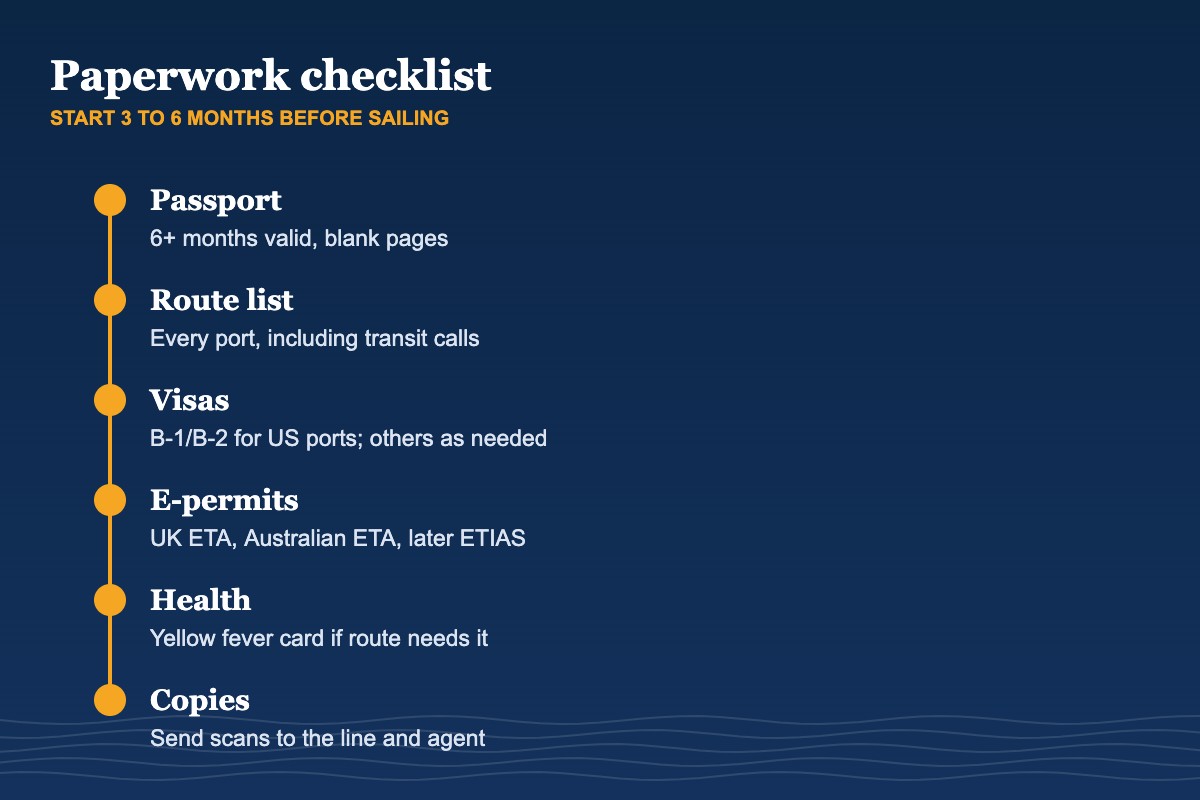
Yes, cargo ship passengers usually need the same visas as any other traveller, and sometimes a stricter one. Freighter passengers arrive by sea on a ship that is not a cruise line, so some visa-waiver schemes do not apply. Check every country on your route, not just where you disembark.
On a cargo ship you do not queue at a passenger terminal. The ship’s agent sends the passenger and crew lists to the authorities before arrival. Officers then clear the ship, often on board, and check passports against those lists. The captain usually holds your passport while you sail.
That has two consequences. First, if your papers are wrong, the whole ship can be delayed, so the line will check your documents before boarding. Second, the shipping line can refuse to carry you if you lack a visa for any country on the route. Most lines ask for copies of your passport and visas weeks before sailing. Our guide on how to book a cargo ship voyage covers that timeline.
Arriving by sea is not the same as arriving by air. Some schemes are written for airline passengers or cruise lines. Others allow any mode of arrival. Read the rules for “arrival by sea” specifically.
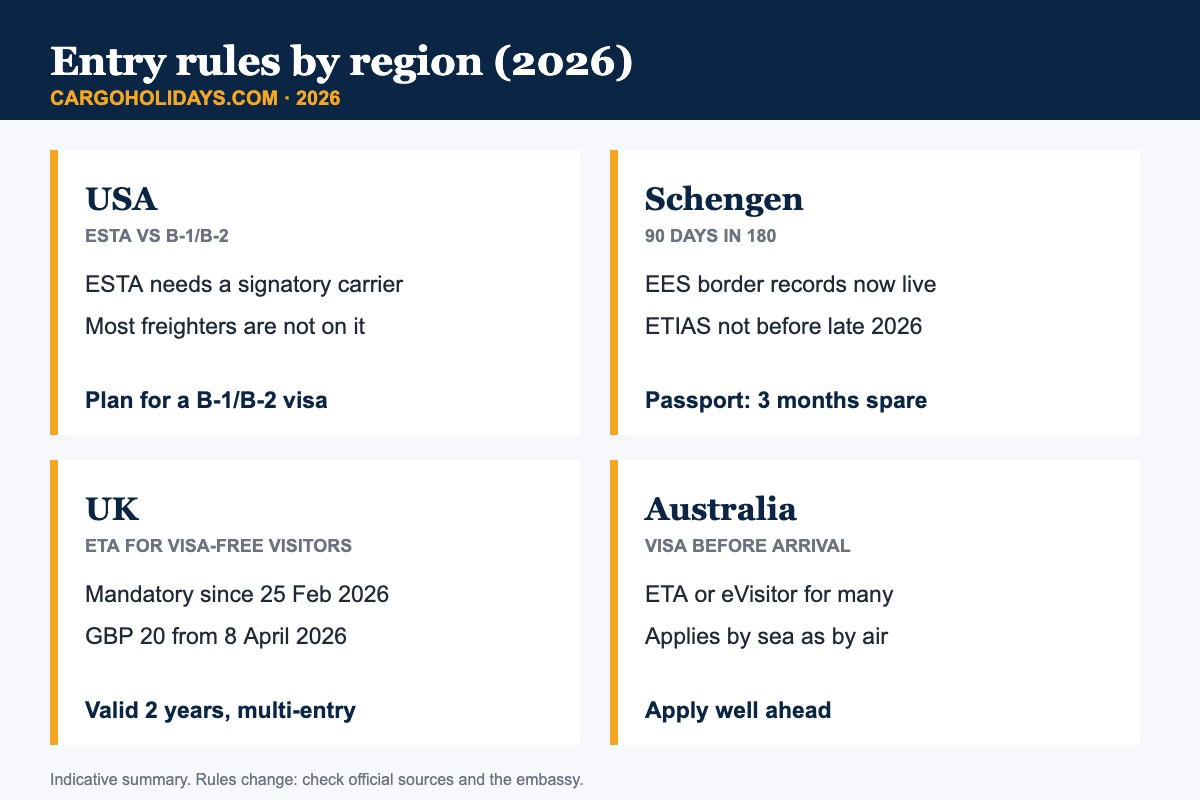
Under the Visa Waiver Program, travellers arriving by sea or air must use a carrier that has signed an agreement with the US Department of Homeland Security. US Customs and Border Protection publishes the list of these signatory carriers. Big cruise lines and airlines are on it. Most cargo shipping lines are not.
So for a freighter calling at a US port, an approved ESTA may not be enough. Freighter passengers usually need a B-1/B-2 visitor visa from a US embassy or consulate. That means an online form, a fee and normally an interview. Waiting times vary by embassy, so apply months ahead. Ask the shipping line directly whether it is a VWP signatory before relying on ESTA.
This applies even if you only stay on board while the ship is in a US port, because you arrive in US waters as a passenger.
| Situation | Typical document | Notes |
|---|---|---|
| Fly in to the US, VWP passport | ESTA | Airlines are signatory carriers |
| Freighter arrives at a US port | B-1/B-2 visa | Unless the line is a VWP signatory |
| Freighter calls, you stay aboard | B-1/B-2 visa (usually) | Line will ask before boarding |
| Non-VWP passport | B-1/B-2 visa | Apply early; interview needed |

For non-EU visitors, the Schengen rule is 90 days in any 180-day period. Your passport must be valid for at least three months after you plan to leave, and issued within the last ten years. Many nationalities still need a Schengen visa.
The Entry/Exit System (EES) records biometrics at external borders and has been rolling out since late 2025. ETIAS, the new travel authorisation for visa-free visitors, is expected to start in late 2026 with a transition period, so it is not likely to be mandatory before 2027. Check the official EU travel site before you sail.
Visa-free visitors to the UK, including EU and US citizens, need an Electronic Travel Authorisation. Enforcement began on 25 February 2026. The fee rose from GBP 16 to GBP 20 on 8 April 2026. An ETA lasts two years or until the passport expires and allows multiple visits of up to six months. It applies to arrivals by sea as well as by air. British and Irish citizens do not need one.
Australia. Everyone except Australian and New Zealand citizens needs a visa or electronic authority before arrival, whatever the mode of travel. Many passport holders can use an ETA or eVisitor, applied for online through the Department of Home Affairs.
China. China has expanded visa-free entry and offers 240-hour visa-free transit for 50+ nationalities at listed ports, but it needs a confirmed onward journey to a third country and the right port of entry. Not every cargo port is on the list, so check with the Chinese embassy.
Other ports. Countries such as Brazil, India and some West African states may need an e-visa or full visa. Rules change often, especially in 2026.
Ports run under the ISPS security code, so you cannot simply walk off. The captain decides if passengers may go ashore. Immigration may issue a shore pass or a landing permit, or add you to a gate list. Some countries give a short shore pass without a visa; others need a full visa even to step onto the quay. Our shore leave guide explains timing and terminal shuttles.
Many countries and shipping lines want at least six months’ passport validity beyond the end of the voyage, plus blank pages for stamps. Voyages can run late, so allow extra margin.
A yellow fever vaccination certificate is required by some countries in West and Central Africa and parts of South America, and by others if you arrive from a risk area. The WHO publishes the country list. Lines also ask for a medical certificate; see age limits and medical certificates.
| Route | Key documents | Watch out for |
|---|---|---|
| Europe to US East Coast | B-1/B-2 visa, passport | ESTA usually not accepted |
| Europe to Australia/NZ | Australian ETA/eVisitor, NZ NZeTA | Transit calls in Asia |
| Europe to West Africa | Visas, yellow fever card | Port-by-port entry rules |
| Europe to South America | Passport, yellow fever card | Brazil and Amazon ports |
| Northern Europe feeders | Passport, UK ETA if visa-free | EES checks at Schengen ports |
Usually not. ESTA needs arrival by sea or air on a VWP signatory carrier. Most freighter lines are not signatories, so passengers normally need a B-1/B-2 visa. Ask the line.
Often yes. You enter the country’s waters as a passenger. The US in particular generally expects the right visa even if you do not land.
No. ETIAS is expected to launch in late 2026 with a transition period and is not expected to be mandatory before 2027. Check the official EU site.
Yes, if you are a visa-free visitor who is not British or Irish. It has been mandatory since 25 February 2026 and costs GBP 20.
A short landing permit or gate list entry that lets ship passengers or crew go ashore in port. Rules vary by country and the captain must agree.
Some West and Central African and South American countries require one, and others do if you arrive from a risk area. Check the WHO list.
Tell us your route and passport, and we will flag the paperwork each port needs.
Get a voyage quote →Sources: US CBP (VWP signatory carriers, 8 CFR 217), US Department of State (B-1/B-2 visas, 9 FAM), GOV.UK (Electronic Travel Authorisation), European Commission travel-europe.europa.eu (EES and ETIAS), Australian Department of Home Affairs, National Immigration Administration of China (240-hour transit), WHO (yellow fever country list). Not legal advice: check with the embassy. Checked November 2026.