The Strait of Gibraltar: Ships, Ferries and Traffic (2026)
By Steve Joury / November 4, 2026
How Strait of Gibraltar shipping works in 2026: traffic lanes, the big ports, ferries to Morocco and Ceuta, cruise calls...
Read More
Last updated: 4 November 2026
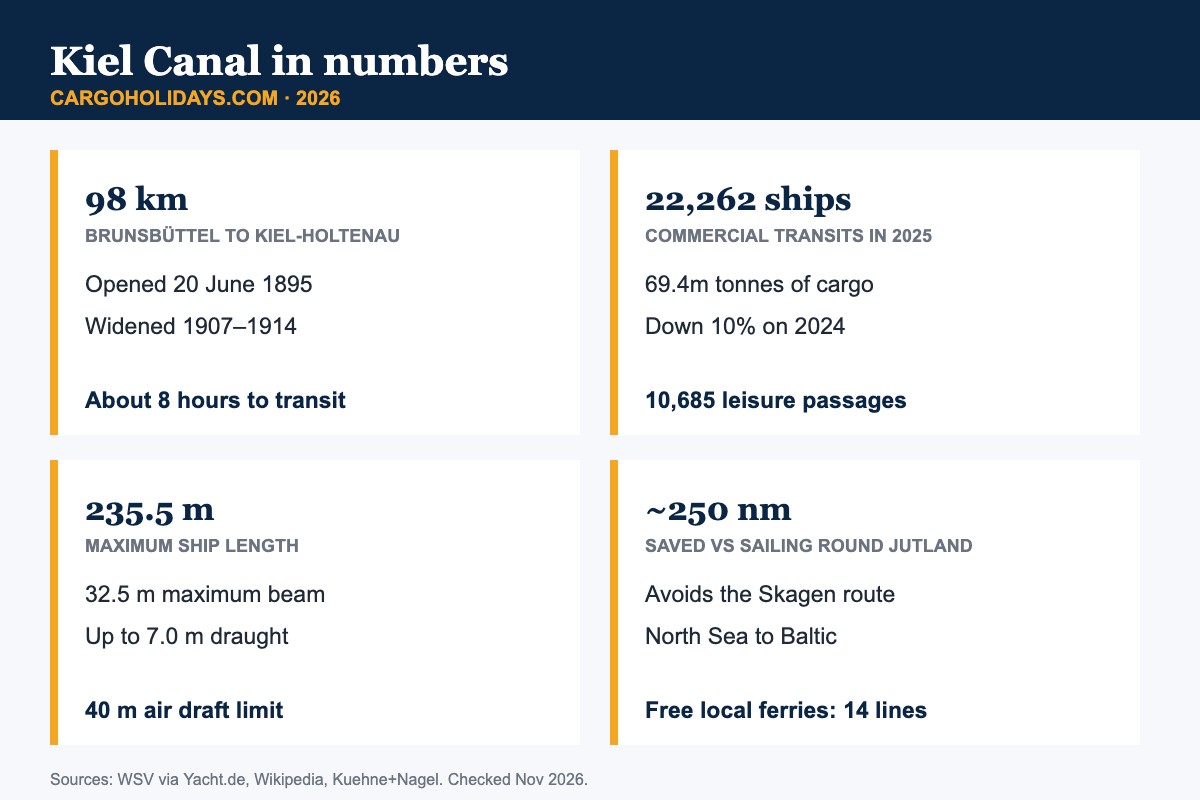
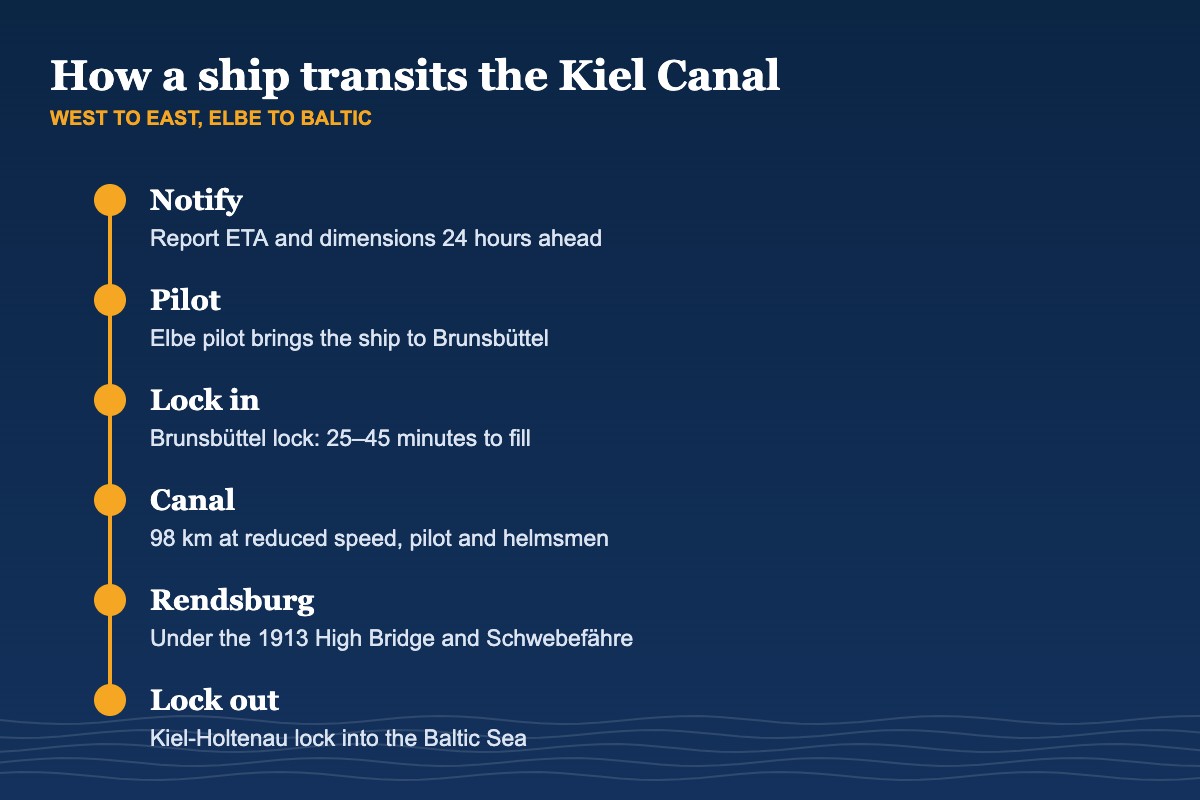
The Kiel Canal is a 98 km ship canal across northern Germany that links the North Sea to the Baltic Sea, and a full transit takes roughly eight hours. It runs from Brunsbüttel on the Elbe to Kiel-Holtenau, and it saves ships around 250 nautical miles compared with sailing round Denmark. It is still the busiest artificial waterway in the world by number of ships, though traffic has fallen since 2022.
Germans call it the Nord-Ostsee-Kanal (NOK). Kaiser Wilhelm II opened it on 20 June 1895. Between 1907 and 1914 it was widened so dreadnought battleships could pass, and the large locks at both ends date from that period.
The canal crosses flat farmland in Schleswig-Holstein. Ships pass under high bridges with about 42 m of clearance. That limits ship height to around 40 m. The water is fresh, not salt.
The federal waterways authority (WSV) runs the canal. It also runs 14 local ferry lines across it, and they are free to use.
Traffic has dropped sharply since the late 2010s. The main reasons given by the WSV are Russia’s war against Ukraine and the sanctions that followed, which cut Baltic trade with Russia. Older infrastructure, construction sites and a lower speed limit have also made transits slower.
There are signs of a small recovery. From January to August 2026, 15,099 ships passed through. That is 138 more than in the same period of 2025. August 2026 alone saw 2,064 ships.
| Year | Commercial ships | Cargo (tonnes) | Leisure passages |
|---|---|---|---|
| 2019 | 28,797 | 83.5 million | – |
| 2024 | 24,866 | 75.6 million | 11,542 |
| 2025 | 22,262 | 69.4 million | 10,685 |
| 2026 (Jan–Aug) | 15,099 | Not yet published | – |
Each end of the canal has a lock complex. Water levels in the canal differ from the tidal Elbe and the Baltic, so every ship must lock in and lock out.
| Lock chamber | Size | Fill time | Notes |
|---|---|---|---|
| Large chambers (1914) | 310 m × 42 m | About 45 min | Used by most seagoing ships |
| Small chambers (1895) | 125 m × 22 m | About 25 min | Smaller ships and leisure craft |
| 5th chamber, Brunsbüttel | Large-ship chamber | – | Under construction since 2012, about €1.3bn |
The new fifth chamber at Brunsbüttel broke ground on 17 April 2012. It was first meant to open in 2013. Structural completion is now expected in the first quarter of 2027. Its job is to act as a bypass while the four old Brunsbüttel chambers, in use since 1914, get a full refurbishment.
At the eastern end, the small Kiel-Holtenau locks need to be rebuilt. The canal’s eastern section is also being widened from 44 m to 70 m. The first 4.3 km widened stretch reopened on 10 November 2025.
A typical commercial transit from Brunsbüttel to the Baltic takes about eight hours. Lock queues can add more. Ships coming from the North Sea must report their ETA and dimensions 24 hours before arrival, then confirm at 12, 6 and 2 hours out.
Larger ships need a canal pilot. Ships over 100 m with a draught above 6.1 m also carry specialist canal helmsmen. Ships over 90 m need tug assistance. Overtaking big ships is only allowed occasionally, so speed is set by the traffic.
The speed limit was cut from 15 km/h to 12 km/h because of bank erosion. Shipping groups say this makes the canal less attractive as a shortcut.
Yes, but it depends on the route. Some Northern Europe and Baltic cruise itineraries include a daylight Kiel Canal transit. Small and mid-sized cruise ships fit. Large modern cruise ships do not, because of the 40 m air draft limit and the 235.5 m length limit.
Freighter passengers can sometimes transit too. Feeder container ships between Hamburg or Bremerhaven and Baltic ports often use the canal. Whether yours does depends on the ship’s size and the operator’s routing on the day, so treat it as a bonus, not a guarantee.
Leisure boats use the canal as well. The Cruising Association’s guide gives a small-craft fee of about €1.20 per metre of boat length (a 2018 figure, so check before you go). Leisure craft may only move in daylight.
The canal is easy to watch from land, and many viewpoints are free.
Canal dues for commercial ships are set by a German federal fees ordinance and depend on the ship’s size. On top of dues, ships pay for pilots, canal helmsmen and tugs as required. Dues were waived for a period during the pandemic, until the end of 2021, to win back traffic.
We have not found a current published tariff table to quote, so we give no figures here. Passengers on a cruise or freighter do not pay canal dues directly. They are built into the fare.
| Canal | Length | Locks | Typical transit |
|---|---|---|---|
| Kiel Canal | 98 km | Yes, at each end | About 8 hours |
| Panama Canal | About 82 km | Yes, raises ships over the isthmus | Most of a day |
| Suez Canal | About 193 km | No, sea-level canal | Most of a day, in convoy |
For the other two, see our guides to the Panama Canal transit and the Suez Canal transit.
The Kiel Canal is 98.26 km long. It runs from Brunsbüttel on the Elbe estuary to Kiel-Holtenau on the Baltic Sea.
A typical commercial transit takes about eight hours from Brunsbüttel to the Baltic, plus any waiting time at the locks.
In 2025, 22,262 commercial ships used the canal, carrying 69.4 million tonnes of cargo. That was about 10% fewer ships than in 2024.
Kaiser Wilhelm II opened the canal on 20 June 1895. It was widened between 1907 and 1914, when the large locks were built.
Small and mid-sized cruise ships can. Ships must be no longer than 235.5 m and no taller than about 40 m, so large modern cruise ships cannot.
Rendsburg is the classic spot, with the 1913 High Bridge and its Schwebefähre transporter bridge. The locks at Brunsbüttel and Kiel-Holtenau are also popular.
Tell us your dates and we will check Hamburg and Baltic feeder routes that may use the canal.
Get a voyage quote →Sources: WSV annual figures via Yacht.de (2025); Transport-Online (2026 traffic and lock works); Wikipedia (Kiel Canal, Rendsburg High Bridge); Kuehne+Nagel transit guide (2024); Cruising Association Kiel Canal info sheet; Seabourn. Checked November 2026.