Importing a Car From South Korea to the UK: Steps & Costs
By Steve Joury / Novembre 1, 2026
Importing a car from South Korea to the UK: NOVA, customs, the approval test and DVLA registration, in the order...
Read More
Ultimo aggiornamento: 26 ottobre 2026 · Di Steve Joury, consulente per i viaggi cargo presso CargoHolidays
A large cargo ship engine can be as tall as a three- or four-storey building and produce tens of megawatts – the biggest marine diesels reach around 80 MW, or over 100,000 horsepower. These slow-speed giants turn the propeller directly. Here’s how they work.
I dati salienti in sintesi
The main cargo ship engine on a large container ship is a long, tall block of steel stretching across several decks of the engine room. The largest marine diesel engines ever built are around 13 metres tall and over 25 metres long, weigh more than 2,000 tonnes and produce roughly 80 MW. Most modern container ships use smaller engines than that, because ships now sail slower to save fuel.

| Nave | Typical main engine power |
|---|---|
| Feeder container ship | ~8 – 20 MW |
| Mid-size container ship | ~30 – 50 MW |
| Ultra-large container ship | ~50 – 65 MW |
| Capesize bulk carrier | ~15 – 20 MW |
| VLCC tanker | ~20 – 30 MW |
Figures are approximate. Speed and power are closely linked – read how fast container ships go e how much fuel a container ship uses.
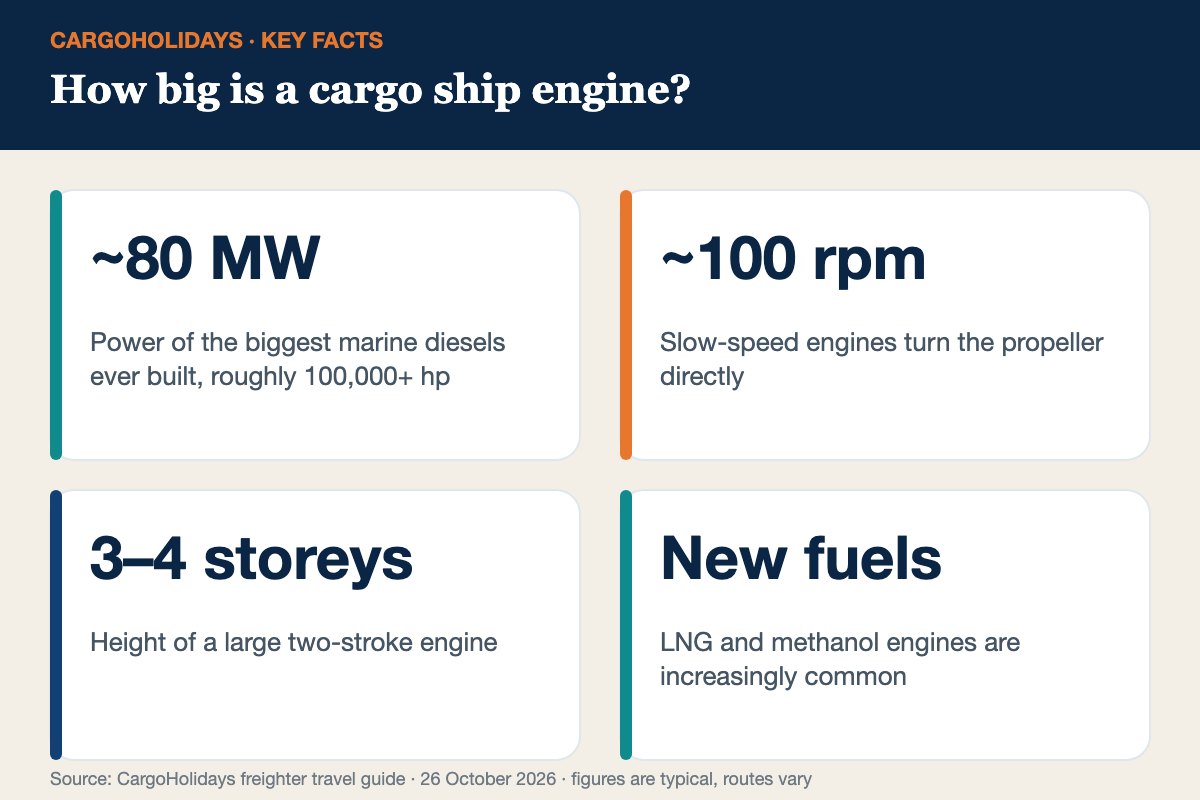
International rules on emissions are pushing shipping towards cleaner fuels. Many new ships have dual-fuel engines that can burn LNG or methanol as well as oil, and some are designed for ammonia in future. Ships also save fuel by slow steaming, better hull coatings and improved propellers.
On a freighter voyage, the chief engineer often offers passengers a tour. You’ll see the main engine, generators, purifiers and the control room, wearing ear defenders. It’s hot and loud – and unforgettable. See inside a cargo ship.
The largest marine diesels are around 13 metres tall, over 25 metres long and weigh more than 2,000 tonnes.
Large container ships typically have tens of megawatts; the biggest engines ever built exceed 100,000 horsepower.
Slow-speed engines turn at around 80 to 100 rpm.
Traditionally heavy fuel oil; today often low-sulphur fuel, with more ships using LNG or methanol.
Often yes, on a guided tour with the engineers.
Tour a real engine room
Sail as a passenger and see the engine room with the chief engineer.
Find my voyage →Preventivo gratuito e senza impegno · Risposta entro 48 ore · Chiedi al capitano · Come funziona la prenotazione