Qu'est-ce qu'un pétrolier ? Types, tailles et fonctionnement
Dernière mise à jour : 26 octobre 2026 · Par Steve Joury, conseiller en voyages de fret chez CargoHolidays
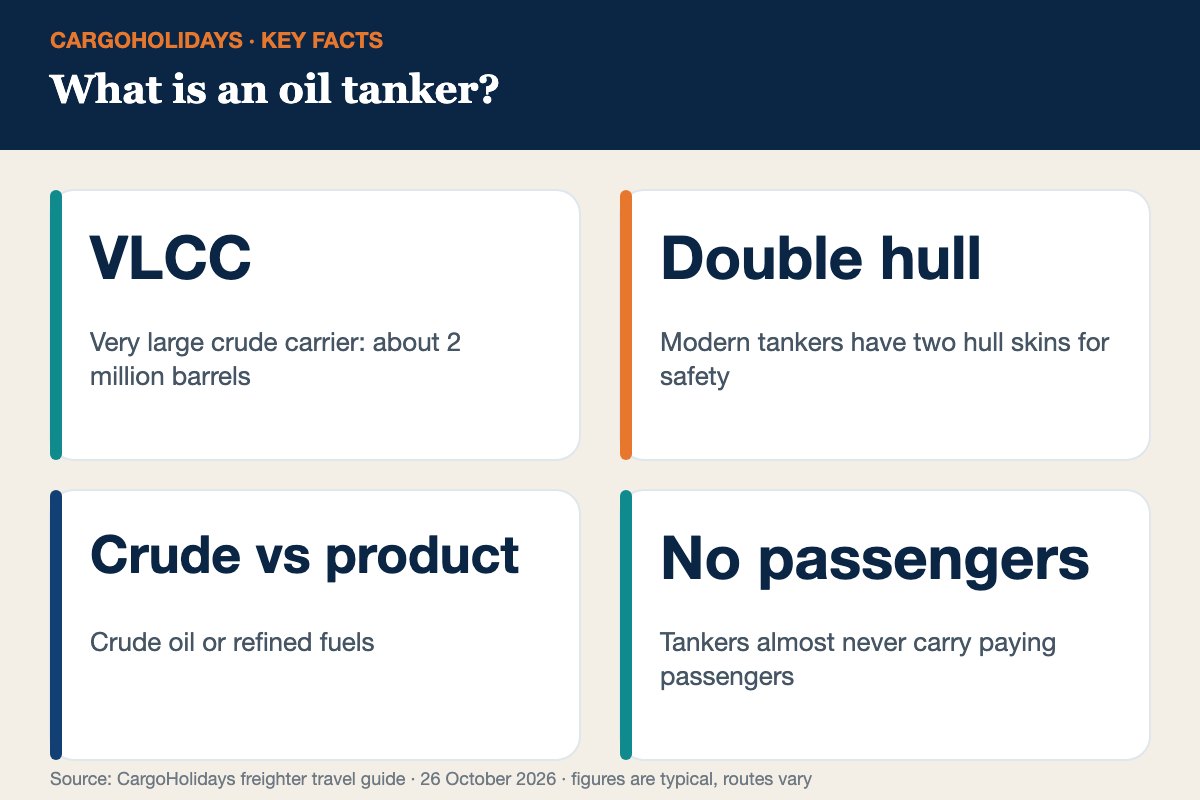
An oil tanker is a ship designed to carry oil in bulk, either crude oil from oilfields or refined products like petrol, diesel and jet fuel. The largest, called VLCCs, carry around two million barrels. Here’s how tankers work and the main types.
Tankers carry crude oil ou refined products in many separate tanks.
Size classes run from Handysize to VLCC and ULCC.
A VLCC carries roughly 2 million barrels of oil.
Modern tankers have double hulls to reduce spill risk.
Because of the hazardous cargo, tankers rarely carry passengers.
Qu'est-ce qu'un pétrolier ?
Qu'est-ce qu'un pétrolier ? It’s a cargo ship whose hull is divided into large tanks for liquid oil, loaded and unloaded by powerful pumps through pipelines on deck. Unlike container ships, tankers have a low, flat deck covered in pipes, with the accommodation block at the stern.
Oil tankers carry crude oil and fuels in many separate tanks.
Tanker size classes
Classe
Approx. deadweight
Typical use
Handysize
10,000 – 50,000 t
Products, regional trades
Panamax
60,000 – 80,000 t
Fits the old Panama Canal locks
Aframax
80,000 – 120,000 t
Crude and products, medium routes
Suezmax
120,000 – 200,000 t
Largest able to transit the Suez Canal loaded
VLCC
200,000 – 320,000 t
Long-haul crude, about 2 million barrels
ULCC
320,000 t +
The very largest crude carriers
Crude, product and chemical tankers
Crude tankers carry unrefined oil from producing regions to refineries.
Product tankers carry refined fuels; their tanks are coated to keep cargoes clean.
Chemical tankers have many small tanks, often stainless steel, for different liquids.
After major spills in the past, international rules required new oil tankers to have double hulls – an inner and outer skin with a gap between. Tankers also use inert gas to keep oxygen out of cargo tanks and reduce fire risk, and crews follow strict safety procedures in port.
Conseil : You can spot a tanker from a distance: low freeboard when loaded, a flat deck of pipes and a small tower near the bow for the cargo manifold crane.
Passionné par le voyage lent et la mer. Steve connaît la plupart des routes maritimes et des procédures pour découvrir notre beau monde depuis la mer sur un porte-conteneurs. Il a participé à la plupart des voyages, de 7 jours en cargo à 140 jours à bord.
Dernière mise à jour : 26 octobre 2026 · Par Steve Joury, conseiller en voyages en cargo chez CargoHolidays. Voyager en cargo au départ de Felixstowe, c'est embarquer...
Dernière mise à jour : 26 octobre 2026 · Par Steve Joury, conseiller en voyages en cargo chez CargoHolidays. Un voyage en cargo au départ de Gênes vous emmène...
Dernière mise à jour : 26 octobre 2026 · Par Steve Joury, conseiller en voyages en cargo chez CargoHolidays. Les voyages en cargo au départ du Havre sont…
Dernière mise à jour : 26 octobre 2026 · Par Steve Joury, conseiller en voyages en cargo chez CargoHolidays. Les voyages en cargo au départ de Rotterdam ouvrent de nouvelles perspectives...
Dernière mise à jour : 26 octobre 2026 · Par Steve Joury, conseiller en voyages en cargo chez CargoHolidays. Il est parfois possible de voyager en cargo...
Dernière mise à jour : 26 octobre 2026 · Par Steve Joury, conseiller en voyages de fret chez CargoHolidays L'ancre d'un navire fonctionne en s'enfonçant...
Dernière mise à jour : 26 octobre 2026 · Par Steve Joury, conseiller en voyages de fret chez CargoHolidays. Les pavillons de complaisance sont des registres d'immatriculation de navires...
Dernière mise à jour : 26 octobre 2026 · Par Steve Joury, conseiller en voyages de fret chez CargoHolidays. Une permission à terre à bord d'un cargo, c'est...
Dernière mise à jour : 26 octobre 2026 · Par Steve Joury, conseiller en voyages en cargo chez CargoHolidays. La piraterie maritime existe toujours, mais…