How Do Ship Anchors Work? Anchors, Chains and Anchoring Explained
Last updated: 26 October 2026 · By Steve Joury, cargo trip advisor at CargoHolidays
A ship’s anchor works by digging into the seabed while the heavy chain lies along the bottom, absorbing the pull from wind and current. On big cargo ships, each anchor can weigh 10 to 30 tonnes. Here’s how anchoring really works.
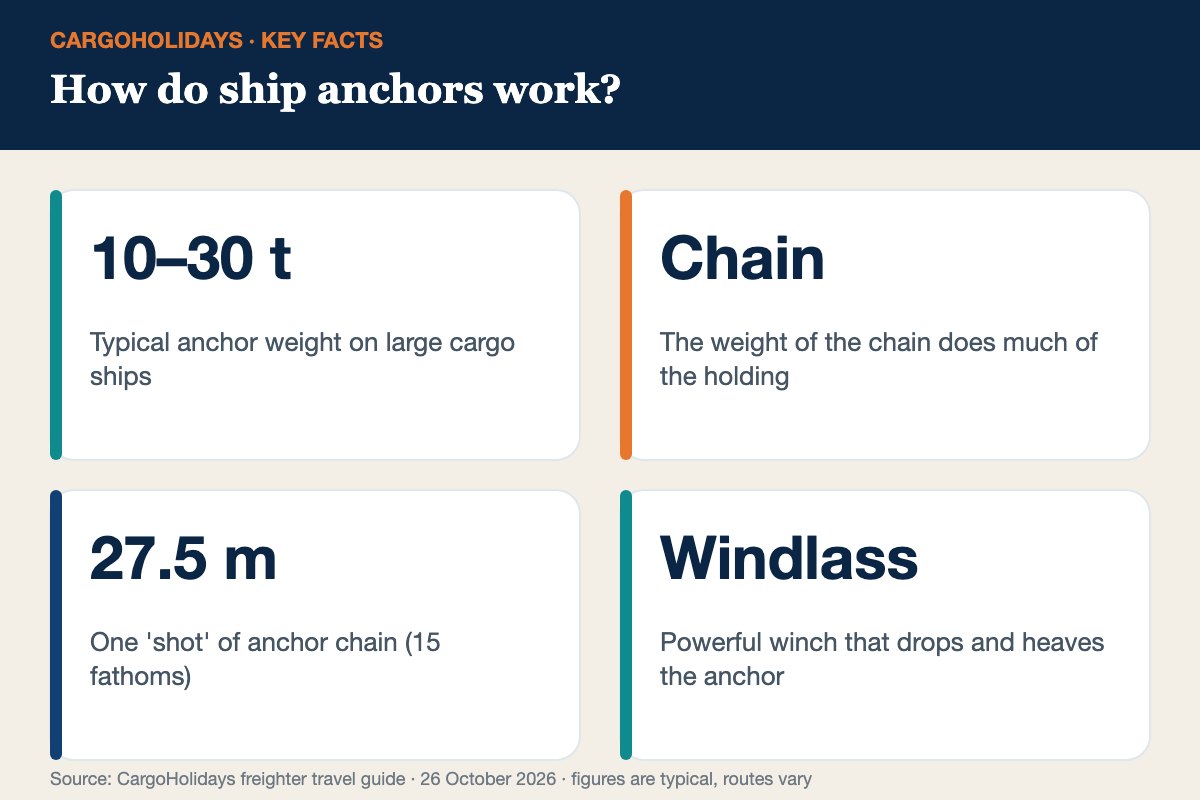
Anchors dig into the seabed; the chain’s weight provides much of the grip.
Large cargo ship anchors weigh roughly 10–30 tonnes each.
Chain is measured in shots of 27.5 metres (15 fathoms).
Ships typically let out several times the water depth in chain.
Anchors are for waiting in shallow water, not for stopping a moving ship.
How do ship anchors work?
People often imagine an anchor as a heavy weight that holds the ship by itself. In reality, how ship anchors work is a team effort: the anchor’s flukes dig into sand or mud, and a long length of heavy chain lies along the seabed. When wind or current pulls the ship, the chain lifts gradually off the bottom, absorbing the load before it ever reaches the anchor. Only in strong conditions does the anchor itself take the full strain.
Ships often wait at anchor outside busy ports.
How heavy is a cargo ship anchor?
Ship
Approx. anchor weight
Small feeder or coaster
2 – 6 tonnes
Mid-size container ship
8 – 15 tonnes
Ultra-large container ship / VLCC
20 – 30 tonnes
Each link of chain on a big ship can weigh well over 100 kg. Ships carry two bower anchors at the bow, sometimes with a spare.
Dropping and raising anchor
The ship slows almost to a stop at the chosen position.
The crew at the bow release the brake on the windlass, and the anchor drops.
Chain is paid out while the ship moves gently astern, laying it along the seabed.
When the anchor “bites”, the officer checks the ship isn’t dragging.
To leave, the windlass heaves the chain back aboard and the anchor is housed.
The rattle of chain running out is one of the most dramatic sounds on a ship – passengers often hear it at dawn while waiting off a busy port.
Ship anchors and chains at a glance.
Why cargo ships anchor
Waiting for a berth outside a congested port.
Waiting for a canal transit, for example the Canal de Panama.
Sheltering from bad weather.
Waiting for orders or cargo.
Anchoring is only possible in relatively shallow water; in the open ocean ships simply drift or keep moving.
Anchoring on a freighter voyage
On many voyages you’ll spend hours or days at anchor before entering port. It’s a peaceful time: calm water, other ships all around and the port lights at night. Bring a book and binoculars. Read inside a cargo ship to see where the anchors are kept.
Tip: Ask the chief officer if you can watch anchoring from a safe spot – it’s a fascinating operation, but stay well clear of the windlass and chain.
Passionné par le voyage lent et la mer. Steve connaît la plupart des routes maritimes et des procédures pour découvrir notre beau monde depuis la mer sur un porte-conteneurs. Il a participé à la plupart des voyages, de 7 jours en cargo à 140 jours à bord.