Last updated: 26 October 2026 · By Steve Joury, cargo trip advisor at CargoHolidays
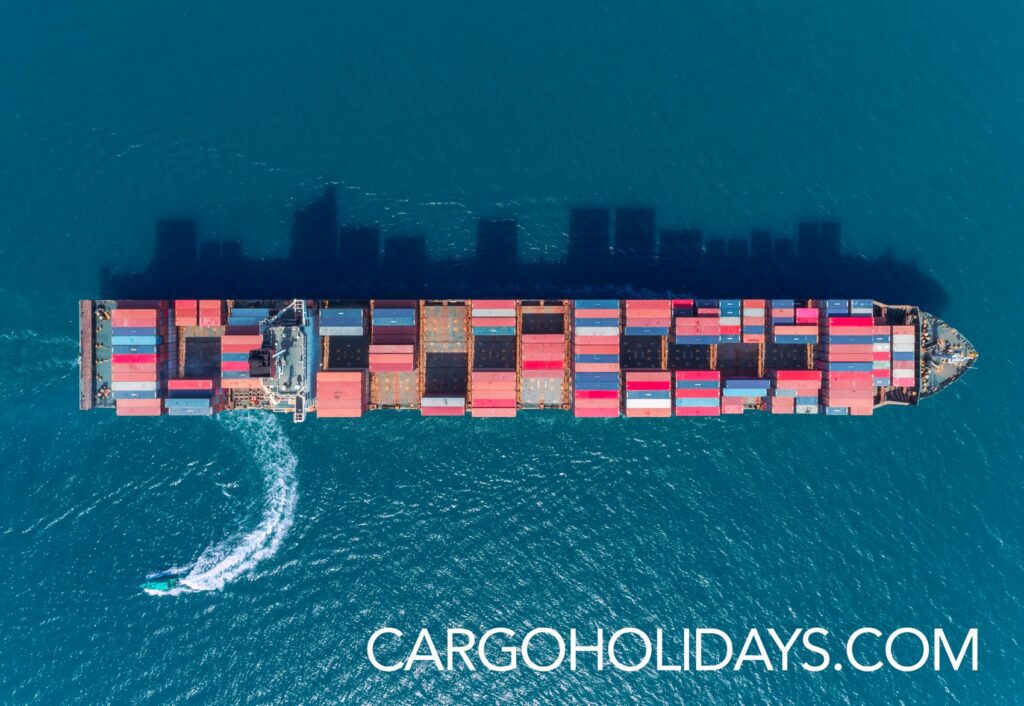
A large cargo ship can weigh well over 200,000 tonnes when fully loaded; the biggest container ships and oil tankers are among the heaviest moving objects people have built. But ‘weight’ in shipping has several meanings. Here’s how ship tonnage works, with typical figures.
Key facts at a glance
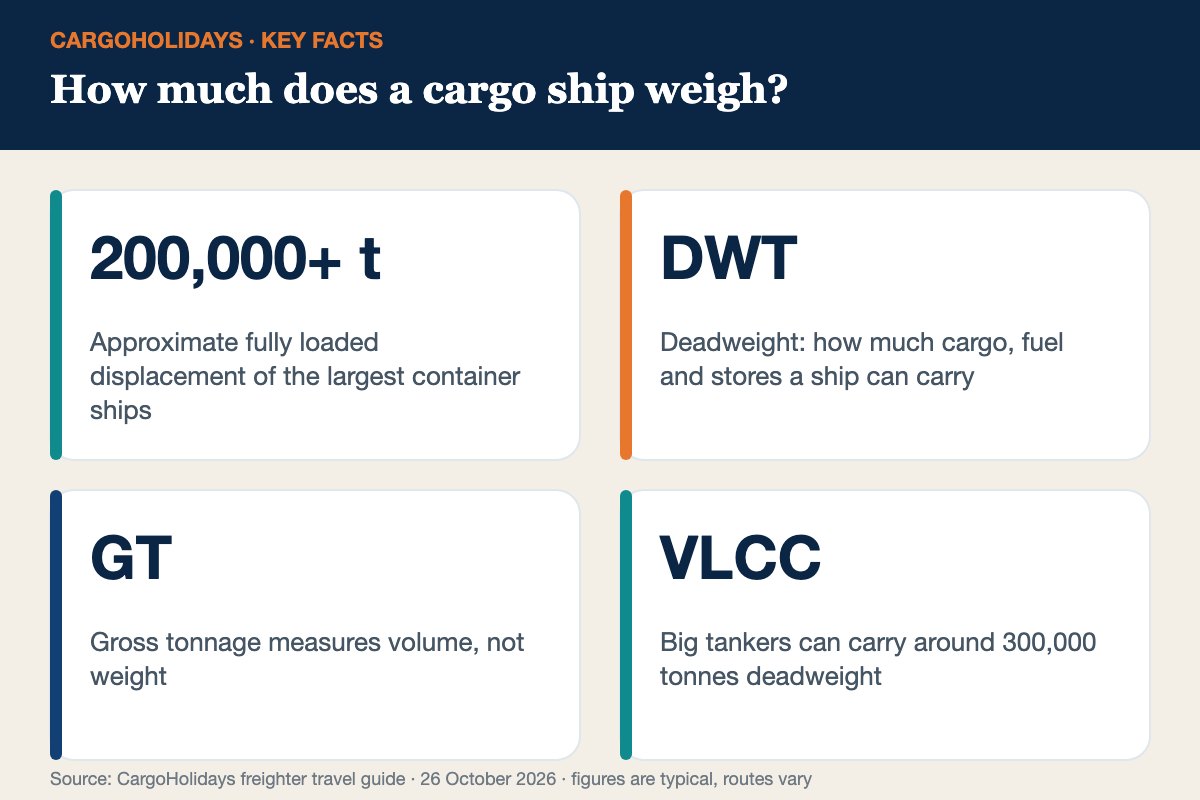
- Displacement is the actual weight of the ship and everything on board.
- Deadweight (DWT) is how much cargo, fuel and stores it can carry.
- Gross tonnage (GT) measures internal volume, not weight.
- The largest container ships have deadweights of around 200,000+ tonnes.
- Very large crude carriers have deadweights of roughly 300,000 tonnes.
The three ways to measure a ship
| Measure | Ce que cela signifie |
|---|---|
| Lightship weight | The empty ship: steel, engines, equipment |
| Deadweight (DWT) | Everything it can carry: cargo, fuel, water, stores, crew |
| Displacement | Lightship + deadweight: the total weight of water the loaded ship pushes aside |
| Gross tonnage (GT) | A measure of enclosed volume used for fees and rules – not a weight |
So when people ask how much does a cargo ship weigh, the honest answer is usually its displacement when loaded.

Typical weights by ship type
| Ship | Approx. deadweight |
|---|---|
| Feeder container ship | 10,000 – 40,000 t |
| Neo-Panamax container ship | 100,000 – 150,000 t |
| Ultra-large container ship (24,000 TEU) | ~200,000 – 240,000 t |
| Capesize bulk carrier | ~170,000 – 210,000 t |
| Very large ore carrier | Up to ~400,000 t |
| VLCC oil tanker | ~300,000 t |
Figures are rounded and vary between designs. For dimensions, read how big is a container ship et les plus grands navires du monde.
How does something so heavy float?
A ship floats because it displaces a weight of water equal to its own weight (Archimedes’ principle). Its huge hull spreads that weight over a vast volume, so the average density of the ship – steel plus all the air inside – is less than seawater. Load more cargo and the ship sinks deeper until it displaces enough water again. Load lines painted on the hull show the safe maximum depth.

Why weight limits matter
A container ship often hits its weight limit before every slot is full, especially with heavy cargo. Officers calculate stability for every voyage, placing heavy boxes low. Too much weight up high makes a ship roll badly – read cargo ships in storms.
Foire aux questions
How much does a cargo ship weigh?
Large cargo ships can weigh well over 200,000 tonnes when fully loaded; small feeders weigh far less.
What is deadweight tonnage?
The total weight a ship can carry: cargo, fuel, water, stores and crew.
Is gross tonnage a weight?
No. Gross tonnage measures the ship’s internal volume.
How does a heavy ship float?
It displaces a weight of water equal to its own weight, and its average density is less than seawater.
What is the heaviest type of ship?
Very large ore carriers and crude oil tankers are among the heaviest when loaded.
Feel the scale for yourself
Stand on the deck of a 200,000-tonne ship as a passenger on a freighter voyage.
Find my voyage →Free, no-obligation quote · Reply within 48 hours · Demandez au capitaine · How booking works
Steve Joury
Les derniers articles par Steve Joury (tout voir)
- Freighter Travel from Felixstowe: Cargo Ship Voyages from the UK’s Busiest Port - octobre 26, 2026
- Freighter Travel from Genoa: Cargo Ship and Ro-Ro Voyages from Italy - octobre 26, 2026
- Freighter Travel from Le Havre: Cargo Ship Voyages from France - octobre 26, 2026