How Big Is a Cargo Ship Engine? Inside the World’s Largest Engines
Last updated: 26 October 2026 · By Steve Joury, cargo trip advisor at CargoHolidays
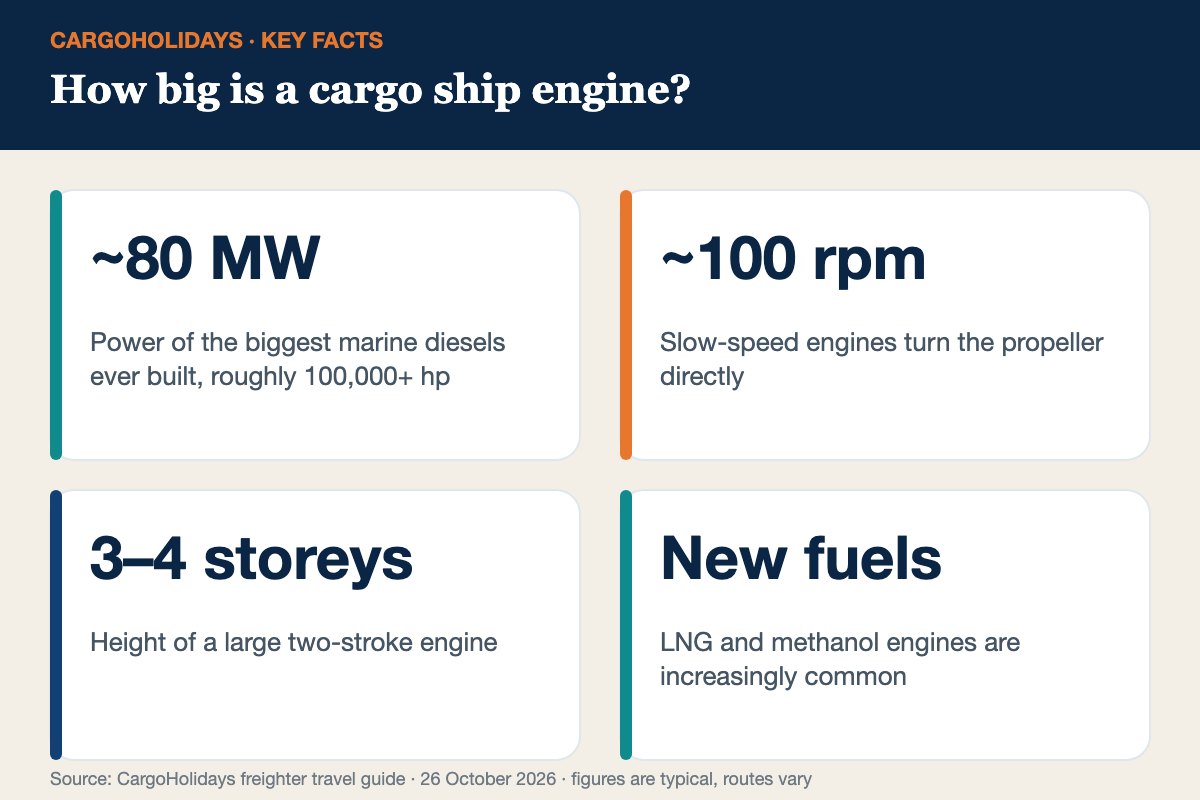
A large cargo ship engine can be as tall as a three- or four-storey building and produce tens of megawatts – the biggest marine diesels reach around 80 MW, or over 100,000 horsepower. These slow-speed giants turn the propeller directly. Here’s how they work.
Big cargo ships use slow-speed two-stroke diesel engines.
The largest produce roughly 80 MW (100,000+ hp).
They turn at only about 80–100 rpm, driving the propeller directly.
A large engine can weigh over 2,000 tonnes.
Newer ships increasingly run on LNG or methanol.
How big is a cargo ship engine?
The main cargo ship engine on a large container ship is a long, tall block of steel stretching across several decks of the engine room. The largest marine diesel engines ever built are around 13 metres tall and over 25 metres long, weigh more than 2,000 tonnes and produce roughly 80 MW. Most modern container ships use smaller engines than that, because ships now sail slower to save fuel.
A single slow-speed engine drives the propeller of most big cargo ships.
How a two-stroke ship engine works
Slow speed: the engine turns at around 80–100 rpm, the same speed as the propeller, so there’s no gearbox.
Huge cylinders: each piston is around a metre across, with 6 to 14 cylinders in a line.
Two-stroke cycle: every downward stroke is a power stroke, giving great efficiency.
Heavy fuel: traditionally burns heavy fuel oil; now often very-low-sulphur fuel, LNG or methanol.
Efficiency: big marine diesels are among the most efficient heat engines in the world.
International rules on emissions are pushing shipping towards cleaner fuels. Many new ships have dual-fuel engines that can burn LNG or methanol as well as oil, and some are designed for ammonia in future. Ships also save fuel by slow steaming, better hull coatings and improved propellers.
Visiting the engine room as a passenger
On a freighter voyage, the chief engineer often offers passengers a tour. You’ll see the main engine, generators, purifiers and the control room, wearing ear defenders. It’s hot and loud – and unforgettable. See inside a cargo ship.
Tip: Wear closed shoes and clothes you don’t mind getting a little oily for an engine room tour.
Apasionado de los viajes lentos y del mar. Steve conoce la mayoría de las rutas marítimas y el procedimiento para descubrir nuestro hermoso mundo desde el mar en un barco de contenedores. Ha estado en la mayoría de los viajes desde 7 días de viaje de carga hasta 140 días a bordo.