12 Freighter Travel Myths, Debunked (2026)
By Steve Joury / novembre 4, 2026
Twelve common freighter travel myths checked against 2026 facts: cost, rules, piracy, cabins, internet, shore leave and carbon.
Read More
Last updated: 4 November 2026
Per passenger, a freighter crossing almost always has a smaller carbon footprint than a long-haul flight or a cruise, but the exact number depends on how you count it. A London–New York return flight in economy is about 1.3 tonnes CO2e using UK government factors. A cruise both ways is roughly double that in CO2. A freighter passenger adds very little fuel, yet no official factor exists for them.
A plane or cruise ship exists to carry people. Its fuel is shared between passengers, so per-passenger factors are straightforward. A container ship exists to carry cargo. It would sail on the same schedule if every cabin were empty.
That raises a fair question. Should a passenger take a share of the ship’s fuel at all? Dr Tristan Smith of UCL has argued that freighter passengers carry little to no share of the CO2, because freight is the ship’s main purpose. Other people prefer a cautious allocation, so the trip is not presented as “free”. Both views are defensible. What matters is saying which one you use.
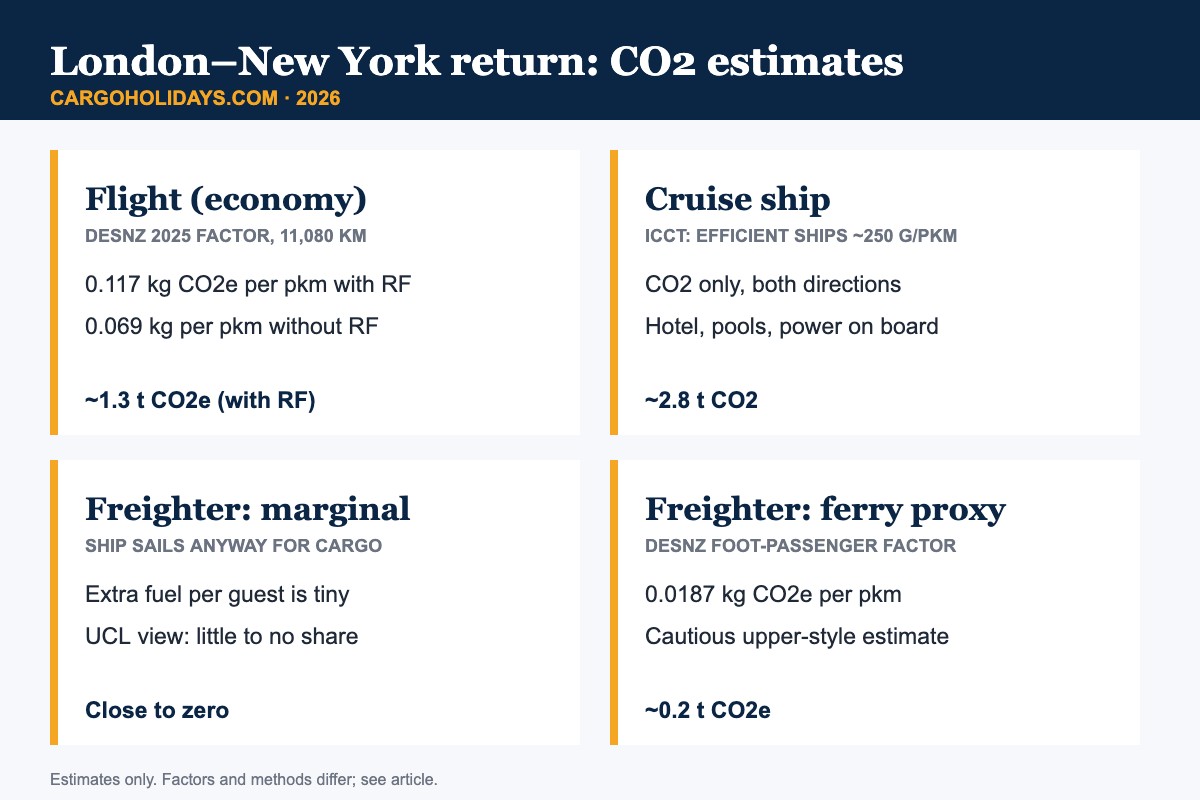
These are the factors we use. Each comes from a named source. Note that they do not all measure the same thing: some are CO2 only, some are CO2e, and only the flight factor includes non-CO2 effects.
| Mode | Factor | Basis | Source |
|---|---|---|---|
| Long-haul flight, economy | 0.117 kg CO2e / passenger-km | Includes radiative forcing | UK DESNZ 2025 |
| Long-haul flight, economy | 0.069 kg CO2e / passenger-km | Without radiative forcing | UK DESNZ 2025 |
| Long-haul flight, average cabin | 0.153 kg CO2e / passenger-km | Includes radiative forcing | UK DESNZ 2025 |
| Cruise ship (efficient) | ~0.250 kg CO2 / passenger-km | CO2 only | ICCT |
| Ferry, foot passenger | 0.0187 kg CO2e / passenger-km | Per passenger | UK DESNZ 2025 |
| Container ship, average | ~0.016 kg CO2e / tonne-km | Per tonne of cargo | UK government factors (2021 edition) |
The ICCT points out that flying’s total climate effect, including contrails, may be around three times its CO2 alone, though this is uncertain. That is why DESNZ publishes flight factors with and without radiative forcing. The 2026 DESNZ edition gives almost the same economy figure (0.11704).

We use a great-circle distance of about 5,540 km each way, so 11,080 km return. For fairness, we apply the same distance to every mode. Real sea routes are longer, and transatlantic freighters usually sail from continental ports such as Antwerp or Hamburg rather than London. Treat every figure below as an estimate.
| Trip (return, 11,080 km) | Calculation | Estimate |
|---|---|---|
| Flight, economy, with RF | 11,080 × 0.117 | ~1,300 kg CO2e |
| Flight, economy, CO2e without RF | 11,080 × 0.069 | ~765 kg CO2e |
| Cruise both ways (efficient ship) | 11,080 × 0.250 | ~2,770 kg CO2 |
| Freighter, ferry-passenger proxy | 11,080 × 0.0187 | ~207 kg CO2e |
| Freighter, mass share (0.1 t person + luggage) | 11,080 × 0.1 × 0.016 | ~18 kg CO2e |
| Freighter, marginal fuel | Extra fuel for one guest | Close to zero |
A common real-world pattern is freighter one way and a flight back. That would be roughly half the flight figure, about 650 kg CO2e with RF, plus the freighter share. Remember the longer trip also means more days of food and onboard power, which some methods would count.
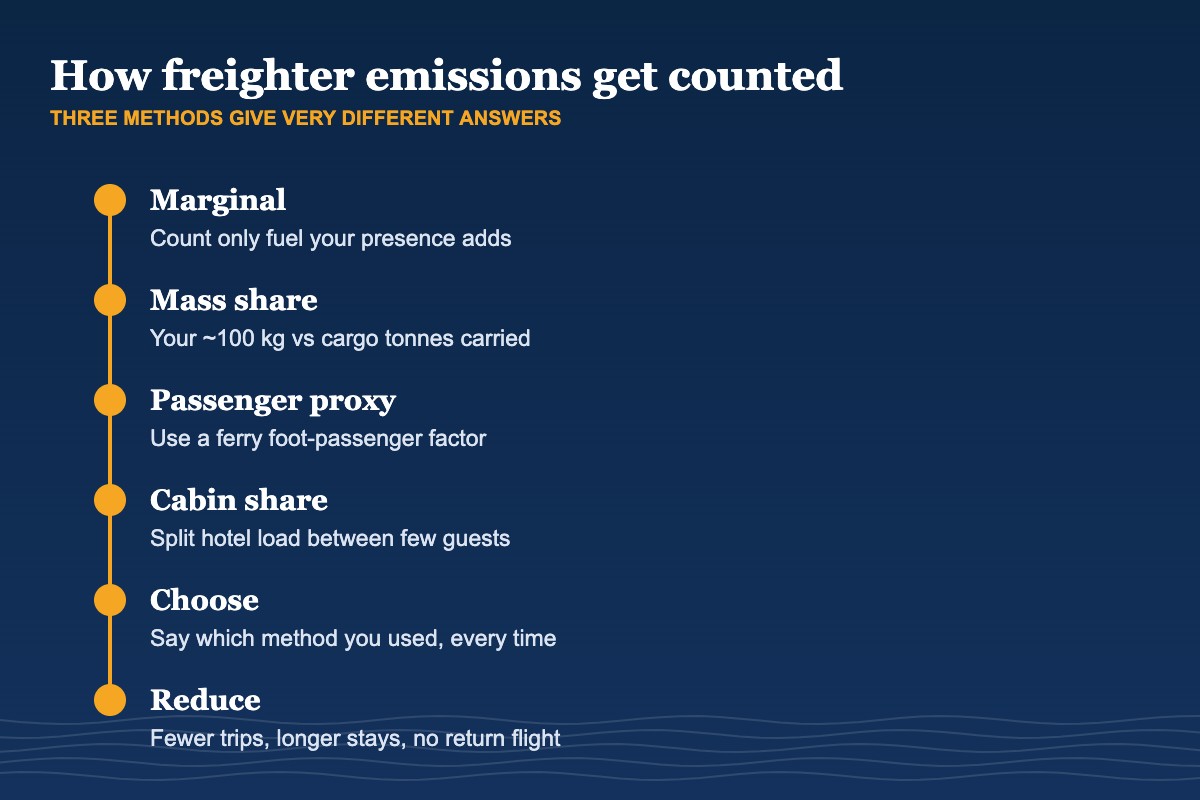
Each method answers a slightly different question. Marginal accounting asks what changes because you booked. Mass share treats you like cargo. A passenger proxy borrows the closest official factor. A cabin share splits the ship’s “hotel” energy between the few guests, which gives a higher figure on small accommodation decks.

Shipping is not clean overall. It burns large volumes of heavy fuel, as our guide to how much fuel a container ship uses explains. In 2023 the IMO adopted a revised strategy: net zero greenhouse gas emissions by or around 2050, with checkpoints of at least 20% cuts by 2030 and 70% by 2040 against 2008 levels.
The tool meant to deliver this is the IMO Net-Zero Framework, a global fuel standard with carbon pricing. In October 2025 member states voted 57 to 49 to adjourn its adoption for a year. At MEPC 84 in April 2026 it was kept as the basis for talks but still not adopted. The next attempt is planned for MEPC 85 in December 2026. Meanwhile, lines are ordering dual-fuel ships that can run on methanol or LNG, and many ships are slow steaming to save fuel.
| Factor | Vol | Croisière | Cargo |
|---|---|---|---|
| London–NY time | ~7–8 hours | ~7 nights | ~9–12 days |
| Who the fuel serves | Passagers | Passagers | Cargo |
| Official per-passenger factor | Yes (DESNZ) | No; studies only | Non |
| Return estimate (this article) | ~0.8–1.3 t | ~2.8 t CO2 | ~0–0.2 t |
| Idéal pour | Speed | Leisure on board | Low marginal impact, slow travel |
There is no official factor. On a marginal basis it is close to zero because the ship sails for its cargo. A cautious ferry-passenger proxy gives about 0.0187 kg CO2e per passenger-km.
Usually yes, per passenger. A London–New York return flight in economy is about 1.3 t CO2e with radiative forcing, against roughly 0 to 0.2 t for a freighter under common methods.
Often. The ICCT estimates even efficient cruise ships emit around 250 g CO2 per passenger-km, more than a typical long-haul flight per km in CO2 terms.
UK government factors give about 16 g CO2e per tonne-km for an average container ship, among the lowest of any freight mode.
It covers non-CO2 effects of flying at altitude, such as contrails. DESNZ publishes long-haul economy factors of 0.117 kg CO2e per passenger-km with it and 0.069 without.
The IMO 2023 strategy targets net zero by or around 2050. Its Net-Zero Framework was not adopted in 2025 or April 2026; adoption is next planned for December 2026.
Tell us your route and dates and we will check freighter cabins for you.
Obtenir un devis de voyage →Sources: UK DESNZ Greenhouse gas reporting conversion factors 2025 and 2026; ICCT analysis of cruise emissions; UCL (Dr Tristan Smith) on freighter passengers; IMO 2023 GHG Strategy; DNV and Carbon Brief on the IMO Net-Zero Framework. All figures are estimates. Checked November 2026.