The Strait of Gibraltar: Ships, Ferries and Traffic (2026)
By Steve Joury / novembre 4, 2026
How Strait of Gibraltar shipping works in 2026: traffic lanes, the big ports, ferries to Morocco and Ceuta, cruise calls...
Read More
Last updated: 4 November 2026
The Strait of Gibraltar is a 14 km-wide channel between Spain and Morocco, and more than 100,000 vessel movements pass through or across it each year. It is the only natural link between the Atlantic and the Mediterranean. Container ships, tankers, car carriers, cruise ships and fast ferries all share the same narrow water. This guide covers how Strait of Gibraltar shipping is organised, the big ports, the ferries and how to see it all yourself.
The strait is about 58 km long. At its shallowest, the Camarinal Sill, it is roughly 300 m deep. Every ship sailing between Northern Europe or the Americas and the Mediterranean, the Suez Canal or Asia must use it. There is no alternative route except going round Africa.
Estimates of traffic vary by source and by what is counted. Most put total vessel movements above 100,000 a year. Around half are merchant ships in transit. The rest are ferries crossing north–south, fishing boats, yachts and naval vessels. That crossing pattern is what makes the strait unusual: fast ferries cut straight across the main shipping lanes many times an hour.
An IMO-adopted traffic separation scheme (TSS) splits through traffic into two one-way lanes with a separation zone between them. As in other schemes, ships keep to the right: eastbound traffic into the Mediterranean uses the southern lane, nearer Morocco, and westbound traffic the northern lane, nearer Spain.
Ships must report under the mandatory GIBREP reporting system, which is run by the vessel traffic services at Tarifa in Spain and Tangier in Morocco. A Moroccan service covers the southern side. Ferries crossing the lanes must give way under the collision regulations and cross as close to a right angle as possible.
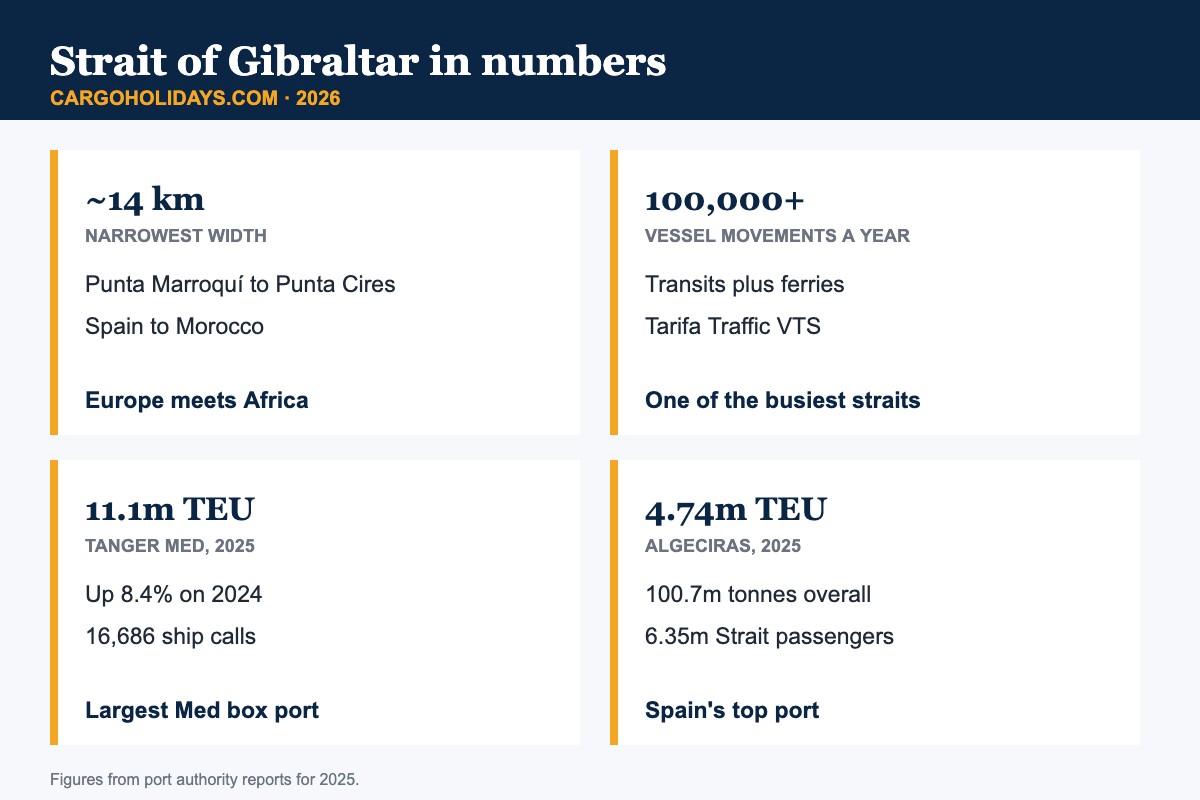
Two of the Mediterranean’s largest container ports face each other across the strait. Both are transhipment hubs. Large ships drop containers here, and smaller feeder ships carry them on to other ports.
| Port | Country | Containers 2025 | Other 2025 figures |
|---|---|---|---|
| Tanger Med | Morocco | 11.1 million TEU (+8.4%) | 16,686 ship calls; 3.22 million passengers |
| Algeciras | Spain | About 4.74 million TEU (+0.5%) | 100.7 million tonnes; 6.35 million Strait passengers |
| Gibraltar | UK territory | Not a container hub | Major bunkering and cruise port |
Tanger Med now handles more containers than Algeciras and Valencia combined. For context on how it compares worldwide, see our guide to the largest ports in the world.

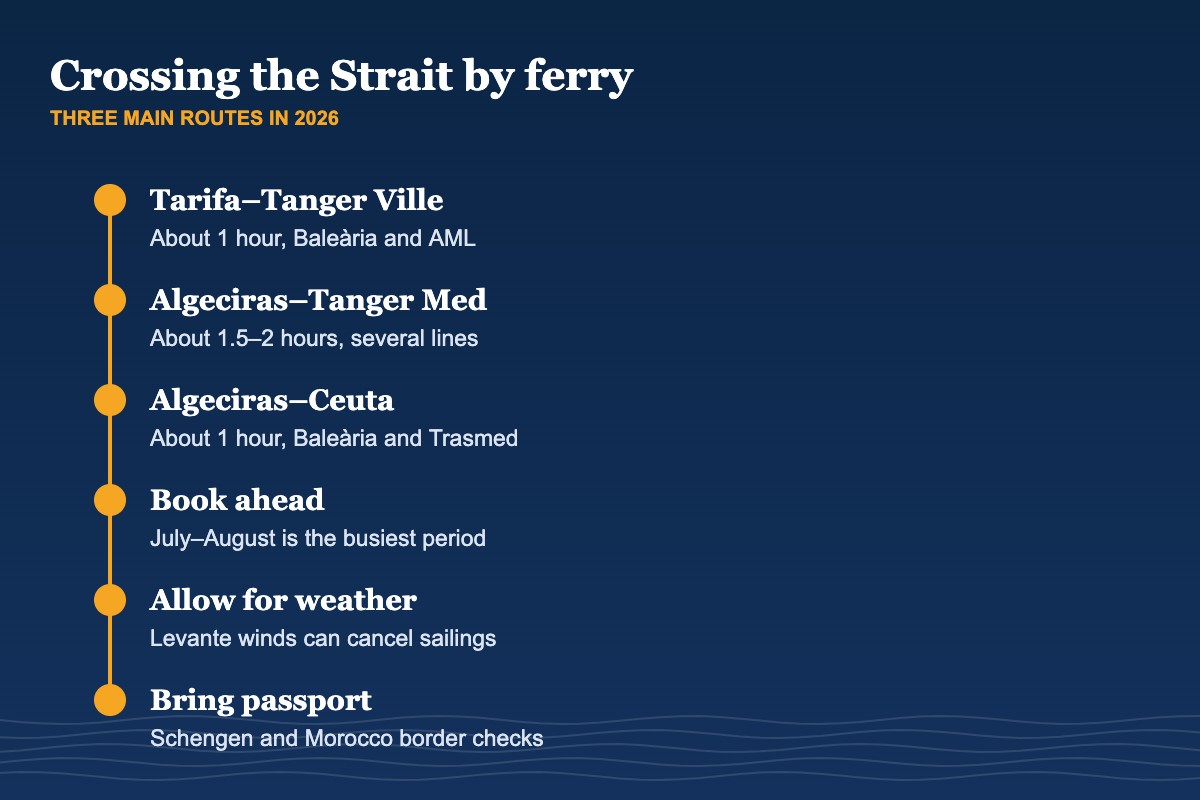
For travellers, the ferries are the easiest way to experience the strait. Three main routes link Spain with Morocco and the Spanish city of Ceuta.
| Itinéraire | Main operators (2026) | Typical crossing | Remarques |
|---|---|---|---|
| Tarifa – Tanger Ville | Baleària, AML | About 1 hour | City centre to city centre; Baleària took over from FRS/DFDS in May 2025 |
| Algeciras – Tanger Med | AML, Baleària, DFDS (FRS) | About 1.5–2 hours | Busiest vehicle route; around 25 sailings a day |
| Algeciras – Ceuta | Baleària, Trasmed | About 1 hour | Ceuta is Spanish territory in North Africa |
Indicative foot-passenger fares on Tarifa–Tanger start from about €27–40 one way, varying by date and operator. Check current timetables before travel. Strong easterly levante winds can delay or cancel crossings. In December 2025 a Baleària ferry to Ceuta turned back to Algeciras during Storm Emilia.
Gibraltar itself is a busy cruise call. April 2025 set a record with 41 cruise calls, and the port expected close to 240 calls for the year, about 28% more than 2024. Lower port costs, an LNG bunkering terminal and short walking distances to the Rock help it compete with Cádiz and Málaga.
Gibraltar is also one of the Mediterranean’s main bunkering stops. Many passing cargo ships anchor in the bay only to take on fuel.
The strait is rich in marine life. Up to seven cetacean species are seen. Common, striped and bottlenose dolphins and pilot whales are present most of the year. Sperm and fin whales pass through mainly in spring and summer. Orcas follow the bluefin tuna and are seen mainly in July and August.
Boat trips leave Tarifa harbour and last about two to three hours. Indicative 2026 prices run from about €30 to €75 per adult. Ships must slow to 13 knots in designated cetacean protection zones.

Many passenger-carrying freighter routes pass Gibraltar. Ships sailing from Northern Europe to the Mediterranean, the Middle East or Asia all transit the strait. Some call at Algeciras or Tanger Med for transhipment. From the deck you see Tarifa, the Rock and the Rif mountains within a few hours.
See our Trajets de cargos en Méditerranée guide for routes. If you prefer a canal transit further north, read about the Kiel Canal transit.
| Saison | Ferries | Faune sauvage | Météo |
|---|---|---|---|
| Spring (Mar–May) | Normal service | Sperm and fin whales | Mild, some wind |
| Summer (Jun–Aug) | Very busy; Operation Crossing the Strait | Orcas in July–August | Hot; levante winds common |
| Autumn (Sep–Nov) | Quieter | Dolphins and pilot whales | Pleasant, some storms |
| Winter (Dec–Feb) | Reduced, weather cancellations | Resident dolphins | Rough seas possible |
About 14 km (roughly 8–9 miles) at its narrowest point, between Punta Marroquí in Spain and Punta Cires in Morocco.
Estimates vary, but total vessel movements exceed 100,000 a year, including through transits and ferries crossing between Spain and Morocco.
Ships follow an IMO traffic separation scheme and report to Tarifa Traffic, the Spanish vessel traffic service, with a Moroccan service covering the southern side.
Tanger Med in Morocco, which handled 11.1 million TEU in 2025. Algeciras in Spain handled about 4.74 million TEU.
About one hour to Tanger Ville. Baleària has operated the route since May 2025, with AML also listed by booking sites.
Yes. Dolphins and pilot whales are seen most of the year, and orcas mainly in July and August. Trips leave from Tarifa.
Tell us your dates and we will find freighter voyages that pass Gibraltar.
Obtenir un devis de voyage →Sources: Tanger Med Port Authority 2025 activity report; Port of Algeciras 2025 figures (Container Magazine); Baleària press release on Tarifa–Tanger Ville; ferry operator timetables (Ferryhopper, aFerry); HM Government of Gibraltar cruise releases; Tarifa whale-watching operators; gCaptain. Checked November 2026.