12 Freighter Travel Myths, Debunked (2026)
By Steve Joury / November 4, 2026
Twelve common freighter travel myths checked against 2026 facts: cost, rules, piracy, cabins, internet, shore leave and carbon.
Read More
Last updated: 4 November 2026
The crossing the equator ceremony is a centuries-old sea ritual in which first-timers (“pollywogs”) are summoned before King Neptune and initiated as “shellbacks”. It is still held on navy ships, sail training vessels, cruise ships and some cargo ships. Today it is mostly good-humoured theatre with a certificate at the end.
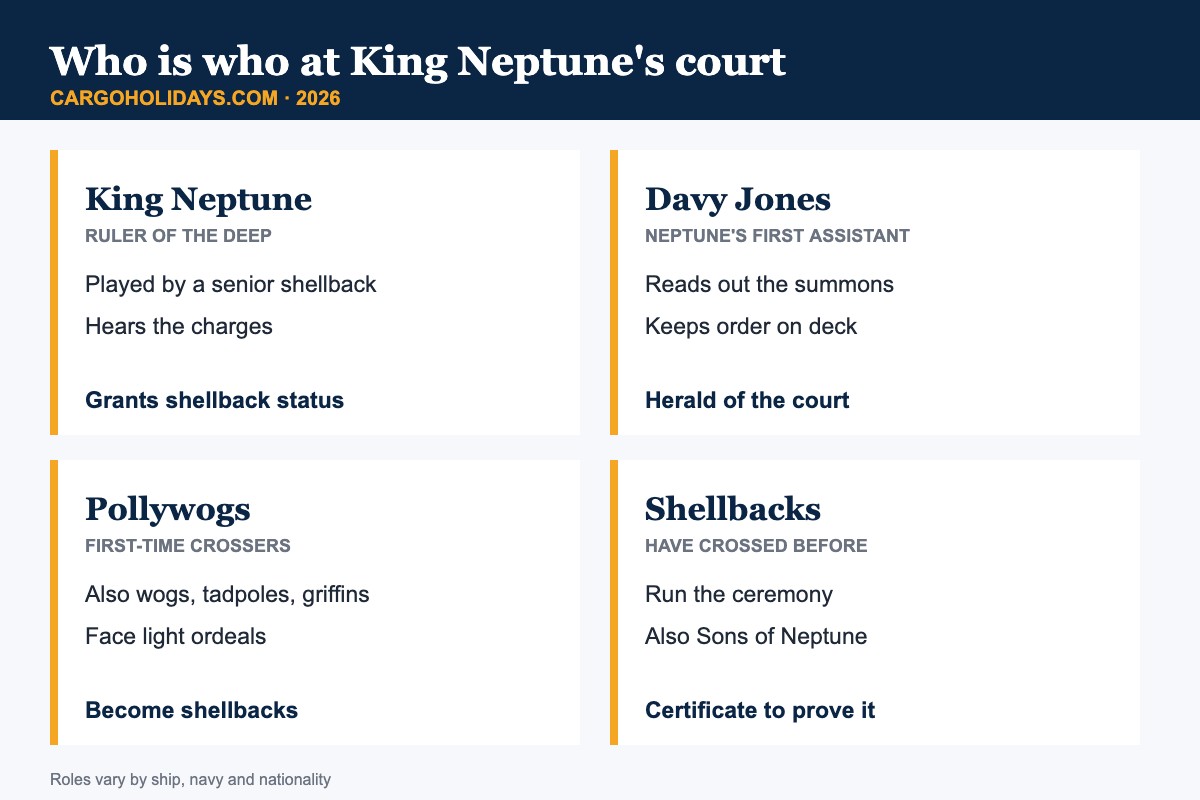
“Crossing the line” means sailing across the equator. Seafarers who have done it are shellbacks, also called Trusty Shellbacks or Sons of Neptune. Those who have not are pollywogs, or “slimy wogs”. In the Royal Canadian Navy they are tadpoles; older British accounts call them griffins.
The night before the crossing, pollywogs usually receive a mock summons to appear before Neptune’s court. On the day, the court charges them with invented crimes against the sea. After their ordeals they are declared shellbacks and given a certificate. Shellback status is unofficial: the US Navy, for example, does not record it on discharge papers.
Nobody knows exactly when it began. Historians link it to older rituals for passing headlands, and to tests of whether new hands could cope with a long voyage. Robert FitzRoy, captain of HMS Beagle, traced it to earlier Spanish, Portuguese and Italian customs.
| Year | Schiff | What was recorded |
|---|---|---|
| 1685 | Oiseau (French, bound for Siam) | François-Timoléon de Choisy writes an early detailed account of a crossing |
| 1768 | HMS Endeavour (James Cook) | Joseph Banks notes first-timers could give up four days’ wine or be ducked three times |
| 1832 | HMS Beagle | A “Neptune” hails the ship on 16 February; Charles Darwin is ducked the next morning |
| 1936 | USS Indianapolis | Franklin D. Roosevelt describes the ceremony in a letter to Eleanor |
| 2021 | HMS Queen Elizabeth | Nearly 1,000 sailors welcomed into “Neptune’s Kingdom” |
Older ceremonies could be brutal, with beatings and, in some recorded cases, deaths. Ceremonies became far more common in the Second World War. From the 1980s navies began to curb hazing. Most modern navies now ban physical abuse, and the California Maritime Academy held its last ceremony in 1989 before it was banned.
The format varies by ship, but the elements are familiar. Senior shellbacks play King Neptune, Amphitrite and Davy Jones, often with a “royal barber” or “doctor”. Pollywogs may wear clothes inside out, be painted, have raw eggs cracked over their heads or drink a “truth serum”. Most ceremonies end with a dunking in water or a hose-down.
Navies keep the tradition for morale. Royal Navy ships including HMS Queen Elizabeth and HMS Diamond held full ceremonies in 2021. Sailors were tested, painted, fed an unappealing snack and dunked. Some ships simply mark the crossing with a toast.
Cruise lines stage a tamer version on deck as passenger entertainment. Crew in costume summon volunteers before Neptune. A Holland America account describes “truth serum” made of hot sauce and aftershave, raw eggs and a certificate afterwards.
On freighters the ceremony depends entirely on the captain and crew. Some hold an “equator baptism” with eggs, paint and a dunking. One merchant version ends with initiates opening a can of beer on the anchor at the first attempt before receiving their certificate. On busy ships it may be a brief moment on the bridge, or nothing at all. If you want to take part, ask the captain early in the voyage.
| Setting | Who runs it | Typical style | Certificate? |
|---|---|---|---|
| Navy ship | Senior shellbacks | Organised, ship-wide, rules on conduct | Usually, unofficial |
| Kreuzfahrtschiff | Entertainment team and crew | Light-hearted show on deck | Often |
| Frachtschiff | Captain and crew | Small, informal, varies by ship | Sometimes |
| Sail training ship | Crew and trainees | Traditional, hands-on | Usually |
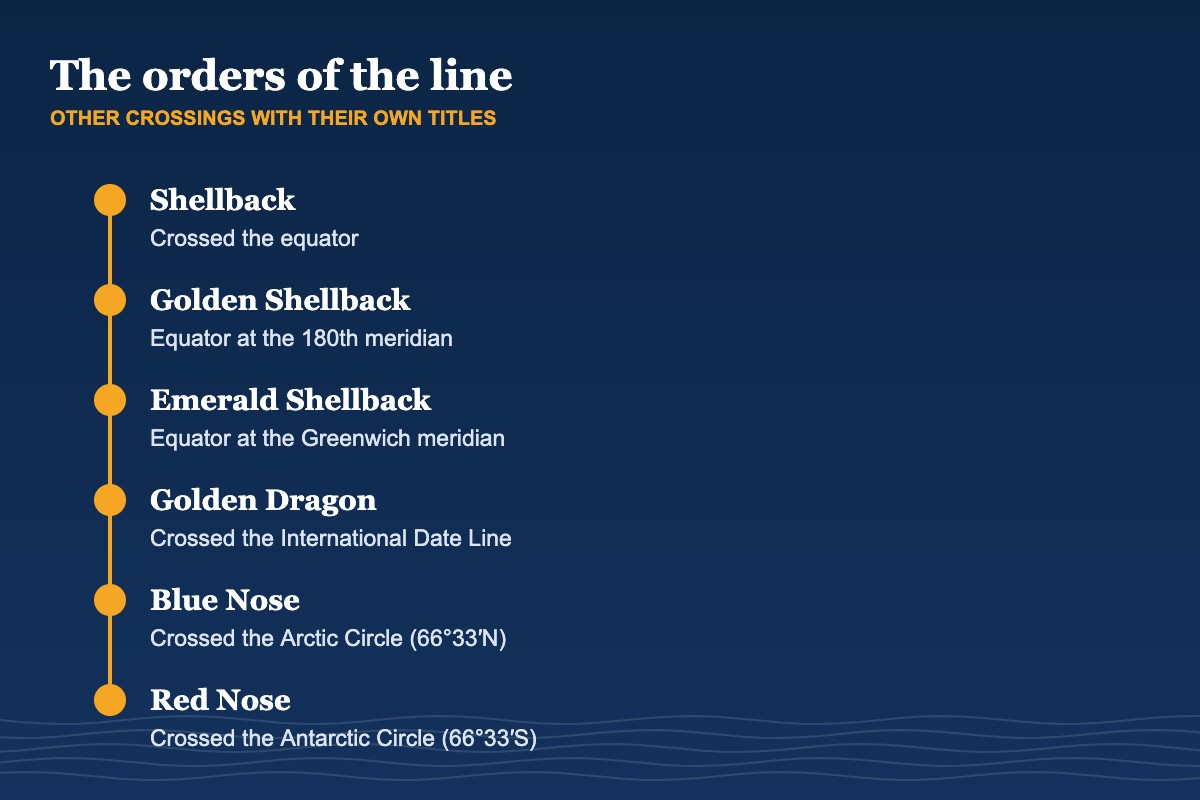
The equator is not the only line with its own title. The US Navy’s list of unofficial certificates includes several more. The rarest is the Emerald Shellback (called Royal Diamond Shellback in Commonwealth navies), for crossing the equator at the Greenwich meridian, in the Gulf of Guinea.
Any voyage between the northern and southern hemispheres crosses the Line. From Europe, these are the main freighter routes where you could become a shellback.
| Route from Europe | Crosses the equator? | Where | Possible extra title |
|---|---|---|---|
| East coast of South America (Brazil, Uruguay, Argentina) | Ja | Mid-Atlantic | Keine |
| West Africa (Dakar, Lagos only) | No – these ports are north of 0° | – | Keine |
| South Africa via the Atlantic | Ja | Gulf of Guinea area | Emerald if exactly at 0° longitude |
| Australia via Suez | Ja | Indian Ocean | Keine |
| Round the world | Usually twice or more | Unterschiedlich | Golden Dragon if crossing 180° |
| Northern Norway / Iceland region | Nein | – | Blue Nose if north of 66°33′N |
Exact crossing points depend on the ship’s routing, weather and port rotation. A Golden Shellback (equator at the 180th meridian) is very unlikely on a commercial route.
A pollywog is someone who has never crossed the equator by sea. After the line-crossing ceremony they become a shellback.
A shellback is a sailor or passenger who has crossed the equator and been initiated before King Neptune’s court.
Davy Jones acts as King Neptune’s first assistant. He typically reads the summons and keeps order during the ceremony.
A Golden Shellback has crossed the equator at the 180th meridian, where it meets the International Date Line.
A Blue Nose has crossed the Arctic Circle at about 66°33′N. Crossing the Antarctic Circle earns the Red Nose title.
Some do. It depends on the captain and crew, and may range from a full “baptism” with eggs and water to a simple certificate.
We can suggest freighter voyages from Europe that cross the equator to South America, Africa or beyond.
Angebot für eine Reise anfordern →Sources: Wikipedia “Line-crossing ceremony”; Naval History and Heritage Command list of unofficial US Navy certificates; Forces News (October 2021); Holland America blog; Marine Insight. Checked November 2026.